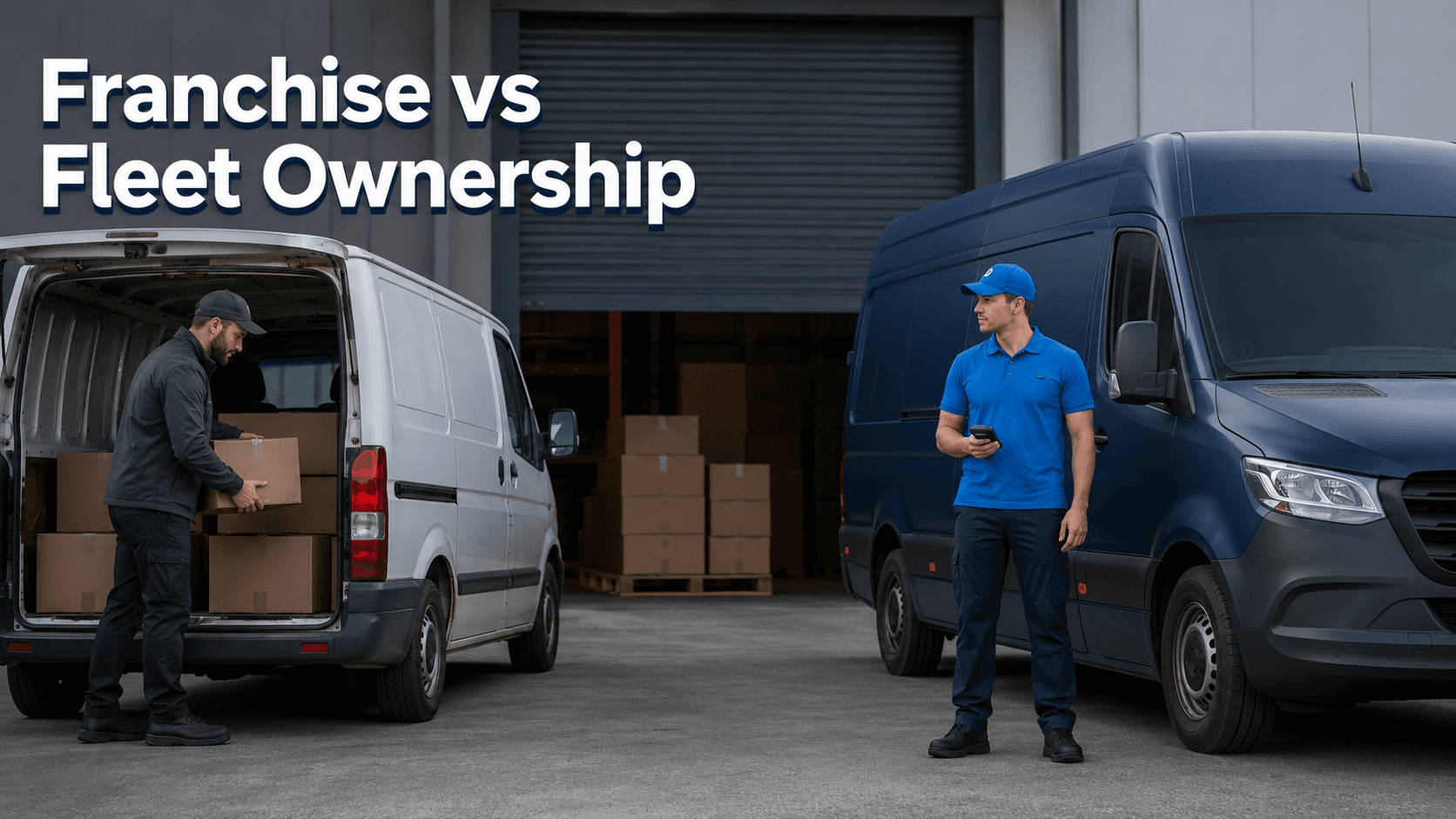
Two vans on the same street, running the same kind of delivery, for two different courier companies. One driver knows the block, follows the delivery instructions, and has been doing the same run for years. The other is new this month, rushing between drops, and gone from the company by the time you'd think to complain about them. The difference usually isn't the driver. It's who owns the van, and what that ownership structure does to incentives, training, and turnover. Understanding whether a courier runs on a franchise model, an employed fleet, or some mix of both tells you more about the service you'll actually get than almost anything on their website. Here's what franchise and fleet ownership actually mean in the Australian courier industry, the legal framework that shapes owner-driver arrangements in NSW, and how a freight broker uses this to match the right ownership model to the right job.
What “Franchise” and “Fleet” Actually Mean
A franchise or owner-driver model means an individual buys or is allocated a delivery run and operates it as their own small business under the parent brand, while an employed fleet model means the courier company owns the vehicles and pays drivers directly as employees. Under a franchise or owner-driver arrangement, the driver typically owns or leases their vehicle, covers their own fuel and maintenance, and is paid per run or per delivery rather than a wage. CouriersPlease, a long-running Sydney-founded courier business, is a well-known example of a franchised courier network in Australia, where operators buy into a run or territory rather than being directly employed. Under an employed fleet model, the company owns the vehicles, employs the drivers on wages, and directly controls training, rostering, and dispatch. This gives the company more direct oversight of how a delivery is actually carried out, at the cost of carrying vehicle ownership, insurance, and staffing overheads itself.
Why Ownership Structure Shapes Service Quality
The economics of each model create different pressures on the person actually making the delivery, and those pressures show up directly in service consistency. An owner-driver in a franchise model is running their own business: their income depends on how many runs they complete and how efficiently they cover their vehicle and fuel costs. In a pricing environment where freight rates are under constant downward pressure, that can push toward speed over care, since time off the road for an owner-driver is a direct income loss, not a paid sick day. It can also mean genuine pride of ownership and route knowledge, since the same person may run the same territory for years and has a direct financial stake in keeping the customers on that run happy. An employed fleet driver isn't carrying the vehicle cost or the income-protection risk, and is typically easier for a company to retrain, redeploy, or hold to a standardised process through centralised GPS dispatch tracking. The trade-off is less personal financial stake in any single customer relationship, and a company carrying the full cost of vehicles, wages, and downtime across its whole fleet. Neither model is inherently better. A franchise network with strong training and fair contract terms can outperform a poorly managed fleet, and vice versa. But the ownership structure is a genuine, checkable signal of what pressures are shaping the driver at your door.
The Legal Backbone: NSW's Contract of Carriage Rules
In New South Wales, owner-driver courier arrangements are legally defined and regulated as a “contract of carriage” under Chapter 6 of the Industrial Relations Act 1996, giving owner-drivers protections that don't automatically extend to every gig-style delivery arrangement. The General Carriers Contract Determination and the Transport Industry Courier and Taxi Truck Contract Determination set minimum rates and conditions for NSW owner-drivers, administered through the NSW Industrial Relations Commission, with the Transport Workers' Union representing contract carriers' interests in determination proceedings. In 2025, the NSW Government introduced further reforms extending Industrial Relations Act protections to transport gig workers, closing a gap that previously left some platform-based delivery arrangements outside the existing owner-driver framework. This matters for a business choosing a courier partner: a franchise operator engaged under a genuine contract of carriage has minimum rate protections that reduce (though don't eliminate) the pressure to cut corners for income. An arrangement structured to sit outside that framework doesn't carry the same floor. This is general information, not legal advice, and the detail of any specific arrangement should be checked with a lawyer where it matters.
How Norwest Logistic Management Uses This When Vetting Carriers
Ownership structure is one of the quieter things a freight broker checks before recommending a carrier, and it's rarely visible from a rate card alone. At NLM, that looks like:
- Matching freight type to ownership model: employed-fleet carriers with centralised dispatch and training for signature-required, high-value, or brand-sensitive deliveries, and well-run franchise networks for flexible, high-volume local and last-mile runs.
- Checking driver tenure and turnover patterns on a route, not just the carrier's headline service promises, since a franchise run held by the same operator for years behaves very differently to one that changes hands every few months.
- Confirming genuine contract-of-carriage terms are in place for NSW owner-driver arrangements, rather than assuming every “franchise” courier sits inside the same protections.
- Using multi-carrier routing to move volume away from carriers, franchise or fleet, whose ownership pressures are visibly showing up as service problems.
[NLM: this is the spot for a real result — e.g. “we moved a Western Sydney client's signature-required freight from a high-turnover franchise run to an employed-fleet carrier and cut delivery disputes by X%.” Swap this placeholder for an actual client result before publishing.]
How to Use Ownership Structure as a Quality Signal
Most businesses never ask who owns the van, but it's one of the more reliable questions you can ask a courier before signing a contract.
- Ask directly whether your route or account is run by an owner-driver franchisee or an employed fleet driver. A carrier that can answer this clearly and confidently is usually one that manages the distinction well.
- Ask about driver tenure on your specific route, not company-wide averages. High turnover on the run handling your deliveries is a stronger warning sign than a general company statistic.
- Match the model to the freight, don't assume one is universally better. High-value or brand-sensitive deliveries generally benefit from the centralised control of an employed fleet; flexible, high-volume local runs can work well on a well-managed franchise network.
FAQ
What's the difference between a franchise courier and a fleet courier? A franchise or owner-driver courier operates their own vehicle as an independent business under a parent brand, paid per delivery. A fleet courier drives a company-owned vehicle as a direct employee, paid a wage. Is a franchise courier legally an employee in NSW? Generally no. Owner-driver arrangements in NSW are typically classed as a “contract of carriage” under Chapter 6 of the Industrial Relations Act 1996, a distinct legal category from employment, with its own minimum rate protections under the General Carriers Contract Determination. Does ownership structure actually affect delivery quality? It shapes the incentives the driver operates under. Owner-drivers carry their own vehicle and income-protection risk, which can push toward speed over care under pricing pressure, while employed fleet drivers are easier to retrain and hold to a standardised process but carry less personal stake in any one customer relationship. What is the General Carriers Contract Determination? It's the NSW industrial instrument, administered by the NSW Industrial Relations Commission, that sets minimum rates and conditions for owner-drivers engaged under a contract of carriage. How does a freight broker use ownership structure when choosing a carrier? By matching freight type to the right model, checking driver tenure on the specific route rather than company-wide figures, confirming genuine contract-of-carriage terms are in place, and shifting volume away from carriers where ownership pressures are visibly affecting service.
Conclusion
The van at your door didn't choose its ownership structure, but that structure shaped almost everything about how it got there: the training, the incentives, the turnover, and the legal protections underneath the driver's income. Asking who owns the fleet isn't a technicality. It's one of the most reliable predictors of the service a business will actually get. If you're not sure whether your current courier's ownership model fits the freight you're sending, talk to NLM about a carrier review.