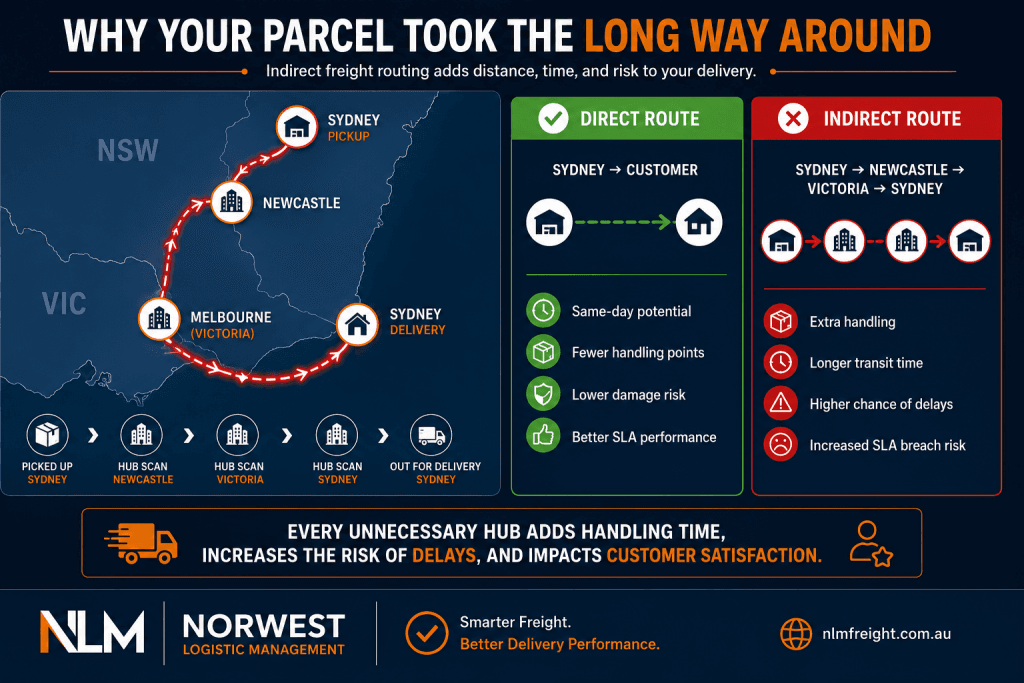
A parcel booked from one Sydney address to another. Simple enough. Except the tracking shows it left Sydney, travelled to Newcastle, crossed into Victoria, and only then came back to Sydney for final delivery. What should have been a same-day metro job became a week-long round trip through two states. It sounds like a one-off horror story. It isn't. It's a predictable consequence of how most freight networks are built, and it's the kind of routing failure that quietly breaches delivery SLAs while everyone involved insists the shipment was “on time” by the letter of the contract. Here's how a freight network can send your parcel the long way round, why that's an SLA problem even when the carrier technically didn't miss a date, and how a broker keeps routing honest.
Why Freight Doesn't Travel in a Straight Line
Most Australian carriers move freight through a hub-and-spoke network, where shipments are consolidated at central hub facilities before being redistributed, and that structure is what makes an indirect route possible in the first place. In a hub-and-spoke model, freight from many origins flows into a hub, gets sorted, and is redistributed outward on trunk linehaul routes to other hubs closer to the destination. Chullora, in Sydney's inner west, is a real example of this kind of node: it hosts a major intermodal freight terminal and Australia Post's Sydney parcel facility, sits on the Hume Highway with direct M5 and M4 access, and is close to both Port Botany and Sydney Airport, which is exactly why so many carriers run depots there. The efficiency case for hub-and-spoke is real: consolidating volume onto high-density trunk routes lowers cost per shipment. The trade-off is that each additional hub a parcel passes through adds handling time, and a shipment can end up routed toward whichever hub has capacity or a scheduled linehaul run, not necessarily the shortest path to its destination.
How a Sydney Parcel Ends Up in Newcastle and Victoria
A shipment can get pulled into a hub outside the direct path when the network prioritises linehaul efficiency over route distance for that specific parcel. If the most convenient scheduled linehaul run for a given carrier that night goes via a regional or interstate hub rather than direct metro cross-docking, a Sydney-to-Sydney parcel can genuinely be routed through Newcastle and Victoria before coming home. Each of those extra hub touches adds dwell time while the shipment waits for the next scheduled leg, and each handling event adds a small but real risk of missorting. None of this shows up to the customer until the tracking history is checked line by line. From the outside, it just looks like the parcel is “late,” with no explanation of why.
Why This Is an SLA Problem Even When the Carrier Says It Isn't
Most freight SLAs measure whether a shipment was tendered or dispatched on time, not whether it was actually delivered within the promised window, and that gap is exactly where indirect routing hides. A carrier can point to on-time delivery rate and transit time adherence figures that look acceptable in aggregate, while a specific shipment quietly absorbs two extra hub touches and several days of dwell time. Once a parcel leaves the sender's hands, liability and accountability for delay typically sit with the carrier managing that leg, not the business that booked the freight, but the customer waiting on the order blames the business regardless of where in the network the delay happened. That's the real cost of “Chullora to nowhere” routing: it's not that any single rule was broken. It's that a technically-compliant network can still produce a badly late, badly routed shipment, and the SLA on paper doesn't catch it unless someone is checking the actual path each shipment took.
How Norwest Logistic Management Fixes This For Sydney Businesses
This is the part of freight brokering that doesn't show up on a rate card: catching a bad route before it becomes a bad delivery. At NLM, that looks like:
- Reconciling the tracking scan history against the direct-distance route for flagged shipments, so an indirect path like an interstate detour gets caught and questioned, not just accepted because the parcel eventually arrived.
- Holding carriers to transit time adherence, not just headline on-time delivery rate, since a carrier can hit its OTD numbers in aggregate while specific shipments are routed badly.
- Routing freight across a multi-carrier network so a carrier whose hub scheduling repeatedly produces indirect routes for Sydney metro jobs can be shifted away from, rather than accepted as “just how that carrier works.”
- Setting SLA terms around actual delivery, not just dispatch, so the measurement matches what your customer actually experiences.
[NLM: this is the spot for a real number — e.g. “we identified and corrected X% of shipments being routed via unnecessary interstate hubs for a Western Sydney client, cutting average transit time by Y days.” Swap this placeholder for an actual client result before publishing.]
How to Protect Your Delivery SLAs From Bad Routing
Most indirect-routing SLA breaches are only visible if someone is actually checking the path, not just the delivery date.
- Ask for scan-level tracking history, not just delivery confirmation. A full scan history shows every hub touch, which is the only way to spot an indirect route.
- Write SLAs around delivered-by dates, not dispatched-by dates. A carrier that’s technically on time for tendering can still be badly late for delivery unless the SLA is written around the outcome the customer feels.
- Get freight audited across multiple carriers, not locked to one network. A single carrier's hub-and-spoke quirks are easier to route around when you're not dependent on that one network for every shipment.
FAQ
Why does freight sometimes travel a much longer route than necessary? Most carriers use a hub-and-spoke network, where shipments are consolidated at central hubs before being redistributed. A parcel can be routed via a hub outside the direct path if that's where the next scheduled linehaul run is heading, adding extra distance and dwell time. Is a badly routed shipment an SLA breach if it still arrives? It depends on how the SLA is written. Many SLAs measure whether a shipment was dispatched on time, not whether it was delivered within a promised window, so an indirect route can breach the spirit of an SLA without technically breaching its wording. What is a hub-and-spoke freight network? It's a freight model where shipments from many origins flow into a central hub, get sorted, and are redistributed outward to their destinations, rather than travelling directly between origin and destination. Who's responsible when a carrier routes a shipment badly? Liability for a delay typically sits with whichever carrier is managing that leg of the network, but the customer waiting on the delivery generally blames the business that booked the freight, regardless of where the delay happened. How does a freight broker prevent bad routing? By checking scan-level tracking history against the direct route, holding carriers to transit time adherence rather than just headline on-time delivery rate, and shifting volume away from carriers whose hub scheduling repeatedly produces indirect routes.
Conclusion
A parcel that travels Sydney to Newcastle to Victoria and back to Sydney isn't a glitch, it's what a hub-and-spoke network does when nobody's checking the path a specific shipment actually took. The SLA on paper can look fine the whole time. Catching this before it costs you a delivery window, and a customer, means checking scan history against distance, not just checking whether a date was hit. If your business keeps hitting unexplained delays on routes that should be simple, talk to NLM about a freight routing audit.